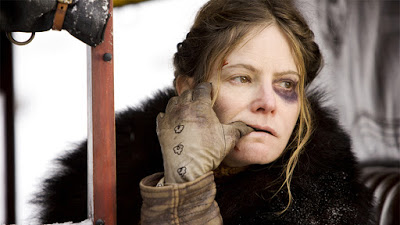
It all begins with a hard elbow to the face.
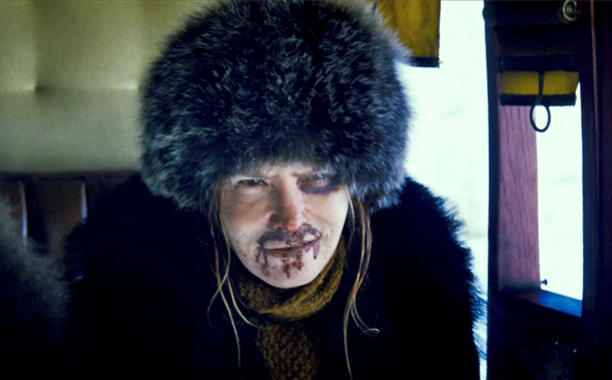
It’s late December 2015, fifteen minutes into an opening weekend matinee of Quentin Tarantino’s The Hateful 8. In a stagecoach bound for Red Rock, John “The Hangman” Ruth has just delivered an unexpected, bone-crunching blow to the nasal bridge of his previously bruised prisoner, Daisy Domergue. Now Daisy’s nose is pouring blood, and bounty hunters Kurt Russell and Samuel L. Jackson are howling with laughter. Worse, the audience around me is bellowing louder. I suddenly feel queasy. Sure, this “Daisy Domergue” is one nasty customer—a convicted murderer, an unrepentant racist who’s generally got what’s coming—but she also happens to be played by one of my favorite actresses, an artist whose work I’ve followed faithfully through the years. In that moment, John Ruth wasn’t just cold-cocking Daisy Domergue. This felt like Tarantino, the director, gleefully punching Jennifer Jason Leigh.
My gut reaction was outrage: “Hasn’t JJL endured enough punishment over the years? Does your overly long, overly loquacious western really warrant this, QT?” Even when Daisy licked the blood from her lips with a masochistic smile, signaling that she took a kind of perverse pleasure in the abuse, I remained uneasy. The whole scene read as needlessly sadistic, especially from a noted cinefile director who must be steeped in her past work. Would Tarantino have treated Pam Grier this way in Jackie Brown? I doubt it. Alas, with JJL he was just getting warmed up.
The brutality heaped upon Daisy only mounted as the movie continued. In the first 20 minutes, she’s not only elbowed harshly in the nose, but also cracked on the head with the butt of a gun and punched out of the moving stagecoach. Over the course of the three-hour film, she has scalding hot stew thrown in her face, blood vomited onto her face, her brother Jody’s brains sprayed onto her point blank. Her front teeth are punched out, her prized guitar smashed to smithereens (a real-life antique). SPOILER: The final images of the film include Daisy being strung up from the haberdashery rafters to die a slow, creaking death before our eyes.
Coming out of the movie, I was shell-shocked. I couldn’t decide if Daisy Domergue was Tarantino’s backhanded celebration of JJL and her past work or just another case of an opportunistic male director putting her through the exploitation film ringer. For those not familiar with Leigh’s filmography, take my word: she’s already suffered plenty of heinous physical indignities onscreen throughout the years. Whether being pulled apart between two semi trucks (The Hitcher), gang-raped by sailors on a shipping dock (Last Exit to Brooklyn) or ravaged by medieval hordes (Flesh + Blood), Jennifer Jason Leigh’s characters have endured their fair share of traumatic events. For a post-grindhouse era actress, sexual violence and its after-effects have featured shockingly regularly on her early CV. For a large swath of her career, she was known for playing victims, prostitutes, addicts, “crazies.” Let’s face it: Many of her characters are less than inspirational figures. Most of her earlier movies would not pass the much ballyhooed Bechdel Test.
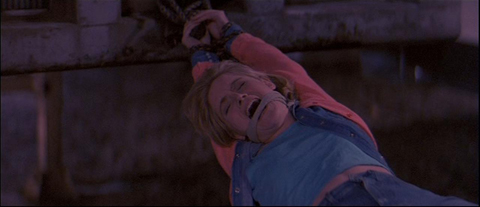
You could argue this was a product of typecasting. But, given comments Leigh’s made in interviews throughout the years, you could also say that she sought out many of these physically and psychically punishing roles. In the ’80s and early ’90s, if you needed an actress to give 110% body and soul to a performance, you had “JJL” on speed dial. Though many of her directors were men with a reputation for artistically rendered sadism (Verhoeven, Schroeder, Altman), Leigh has also worked with a more than average number of female directors (Lili Zanuck, Angelica Huston, Agnieszka Holland). Violence, and more specifically sexual violence, was not just an unfortunate side item in her work; it seemed to be the running theme, one she was choosing voluntarily to explore.
When Jennifer Jason Leigh was nominated for Best Supporting Actress for her performance in The Hateful 8 a few months later, I was still in something of a quandary about her Daisy Domergue. On the one hand, the nomination seemed like the Academy being late to their own party as always, playing catch-up with a great actor they should’ve showered awards upon years ago. If it were my vote, JJL would’ve already snagged a Best Actress Oscar in the mid-’90s for one of her stellar leading roles in Georgia or Mrs. Parker and The Vicious Circle, if not both. On the other hand, why quibble? Leigh was finally being recognized by the industry, even if it was for a lesser Tarantino film, one that largely kept her silent among bloviating men for the duration.
I decided to investigate further, revisit Leigh’s filmography from the beginning, re-watch some of my Jennifer Jason Leigh favorites and catch up on some of her lesser-known films. It would take me approximately 25 movies and several loose groupings of the roles she’s played throughout the years. Was Daisy Domergue an unfortunate late-career aberration or the perfect culmination of her uniquely visceral talents after 30+ years in the business?
The Good Girls: Tracy, Casey, Stacy
Eyes of a Stranger (1981)
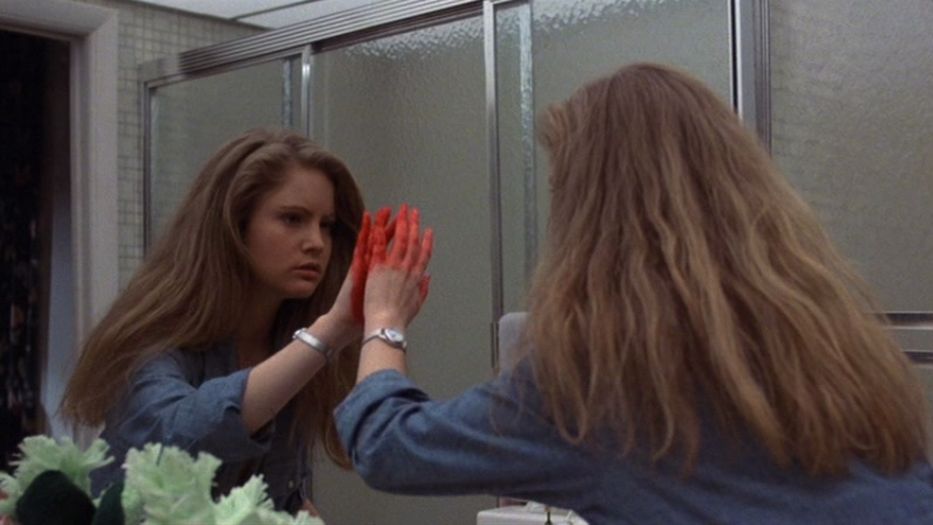
An uncredited guest spot on TV’s Baretta notwithstanding, JJL’s first silver screen appearance at the age of 18 was in this relatively routine slasher flick. Here, she plays Tracy, the blind, deaf and mute teenage daughter of a TV anchorwoman (Lauren Tewes) who’s investigating a local serial killer. For the most part, JJL’s role is marginal. If it weren’t for the last 20 minutes, you could write the whole thing off as Leigh earning her obligatory SAG card (and, reportedly, losing out on her real life high school diploma at the same time). But in the closing minutes, when young Tracy becomes the focus of the killer’s revenge and is brutally attacked in her home by an assailant she is unable to hear or see, a real actress emerges in the process…as well as a recurrent theme. In a questionable turn of events, the attack that Tracy narrowly escapes miraculously restores her hearing, vision and speech, all of which she finds again in a stirring moment staring at herself in the bathroom mirror once the killer is dead. Redemption/renewal through violation? This seems to be what this otherwise run-of-the-mill horror flick is so recklessly suggesting.
The Best Little Girl in The World (1981)
That same year, Leigh would star in a TV movie which would become her serious actor calling card, a role which was originally offered to the already established Jodie Foster. Like Christian Bale in The Machinist (a movie JJL also appeared in years later), young Leigh would shed a massive amount of weight (a reported 86 pounds) to take on the role of Casey, a suburban teen battling anorexia. For a prime-time “ABC Movie of the Week,” the telefilm contains some heavy adult subject matter. Though the script generally pins the cause of Casey’s eating disorder to her parents’ obliviousness (she’s the family “good girl,” her older sister the “bad girl” who gets all the attention), her vomiting and furious midnight sit-up regimens don’t really begin until she’s nearly date-raped in a parked car by an overzealous high school crush. Soon, Casey is dropping an alarming amount of weight and being force-fed peanut butter sandwiches by her desperate father (Charles Durning). Several hospitalizations later, she’s finally got a caring therapist (Jason Miller) with a pinball machine in his office who convinces her to talk out her feelings and indulge in the healing powers of ice cream. Remember, this was network TV.
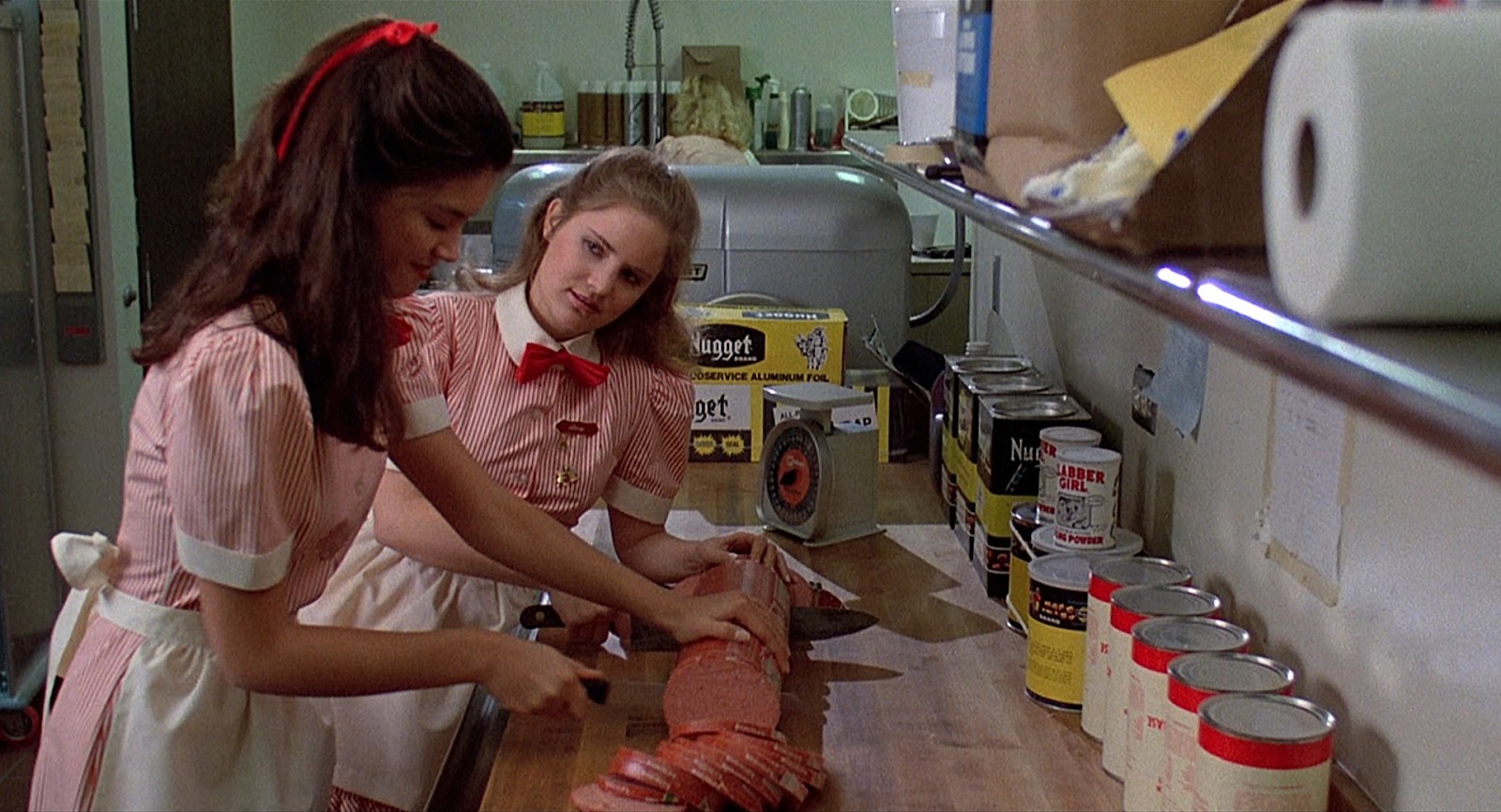
Fast Times at Ridgemont High (1982)
If you’re familiar with any of Leigh’s early work, then you’re probably most familiar with Stacy Hamilton, Ridgemont High’s (and Tom Petty’s) resident “American Girl.” Stacy was Leigh’s breakout role, and Fast Times the movie that truly catapulted her film acting career, not to mention a few of her contemporaries. For a relatively good-natured ’80s high school coming of age comedy, it still seems refreshingly candid about sex, the growing pains of making out and hooking up. Though a hopscotching ensemble piece, the movie’s emotional core is, without a doubt, Stacy. The script is built around her first tentative forays into relations with the opposite gender, and Leigh proves the very relatable center axis around which a dozen or more characters spin. Whether she’s learning fellatio techniques from her more experienced friend, Linda (Phoebe Cates), having sex for the first time with an older man in a baseball dugout under a disturbing splash of graffiti (“Surf Nazis”) or falling prey to a poolside “fuck-n-run” from the school’s resident ticket scalper, Damone (Ray Romanus), JJL suffers a host of sexual disappointments. Of all the bad things that happen to Leigh’s characters throughout her career, one could argue that Damone’s failure to show for her scheduled abortion appointment is a particularly cruel low. But, never ye fear, this was a movie penned by Cameron Crowe, so JJL does get the nice guy in the end (Brian Backer). Even if he also happens to work at the mall movie theater and is nicknamed “The Rat.”
The Bad Girls: Allison, Agnes, Allegra
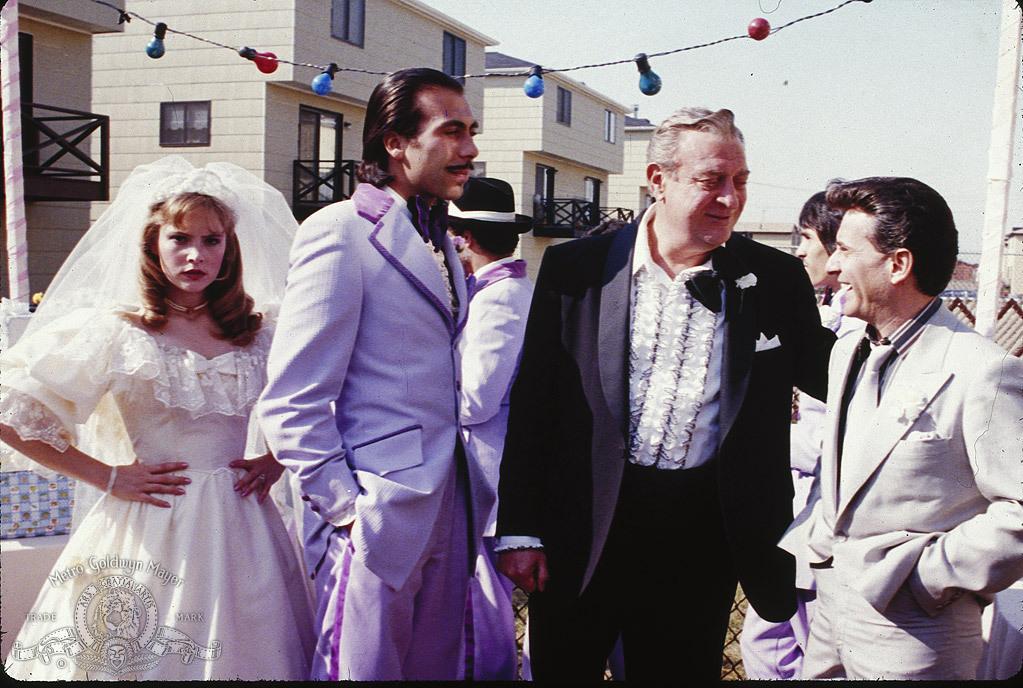
Easy Money (1983)
After graduating Ridgemont High and a second TV movie where she was sold into a white slavery karaoke ring in Japan (Death Ride to Osaka, 1983), JJL was finally getting offered a few “bad girl” roles. By “bad girls,” I don’t mean Daisy Domergue bad, more like adventurous, liberated women who actively enjoyed sex on their own terms (i.e., “modern”). Easy Money is mostly a throwaway in JJL’s career—an intermittently funny Rodney Dangerfield comedy in which her role as his Irish Catholic daughter is little more than a glorified cameo. Leigh’s “Allison” begins the movie as a wedding night virgin, appalled by the acts her new husband (Taylor Negron) is suggesting in their roadside motel honeymoon suite. But it only takes a few pages into The Joy of Sex before she’s getting with the program so much that she’s running the program, a source of considerable worry to her husband. He suspects that his new bride has become a overnight sex freak.
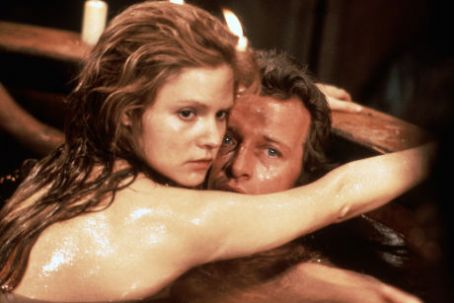
Flesh + Blood (1985)
Leave it to director Paul Verhoeven to bestow Jennifer Jason Leigh with what is arguably her best “bad girl” role. Agnes is a spoiled 15th century Plague-era princess raised in a repressive convent and now chomping at the bit for Experience with a capital E. She forces one of her handmaidens to have sex with a field worker for her personal entertainment, then sups on wine and mandrake root and suggests to her husband-to-be (Tom Burlinson) that they do the same. Before the newlyweds get a chance to consummate, Agnes is stolen away by a band of mercenaries headed by Rutger Hauer. On the verge of being ravaged by his men, Leigh is “saved” by Hauer…but only so he can have her for himself.
What would normally be just another exploitative, male-directed rape scene soon takes on an added layer when JJL’s character turns the tables on Hauer in the middle of the act. “You think you’re hurting me, but I like it,” she says looking him fearlessly in the eye, robbing him of all conquesting pleasure. Theirs is an S&M-tinged relationship, one that lays some groundwork for the Daisy Domergue-John Ruth dynamic in The Hateful 8. The two soon become something like equal partners in sex and pillaging. JJL even gets “top-billing” in the medieval hot tub scene. Only during the film’s conclusion, when she’s finally “rescued” by her husband, does it dawn on Agnes what has actually occurred. “I just realized what happened to me,” she says, as if coming down from a nasty case of Stockholm Syndrome in lieu of escaping the Black Death.
Existenz (1999)
Though Leigh played numerous world-weary escorts and sex workers in the intervening years after Flesh + Blood, it wasn’t until David Cronenberg’s virtual reality teaser at the end of the ’90s that another of her characters was given the opportunity to gleefully embrace the peculiar comforts of perversion, assume the dominant role. Here she plays Allegra, the designer of a virtual reality game called Existenz. All the game controllers resemble female genitals and need to be stimulated by touch in order to start the game. As the game’s creator, JJL operates like a Greek goddess or deified dominatrix within the world of Existenz, and the security expert (Jude Law) accompanying her through the labyrinthine storyline functions as her fall guy/boy toy. Watching the movie again, I began to lose track of the number of times JJL mischievously licks her finger and penetrates the “bio-port” at the rear of Law’s back, a highly suggestive combination of USB slot, anus and tramp stamp. In Existenz, it seems Cronenberg has given JJL (at age 37) her most empowered role. The delight Allegra takes in toying with the men in her game is like watching JJL get some measure of revenge on the more pedestrian parts of her resume.
The Crazies: Lucy, Carol, Hedy
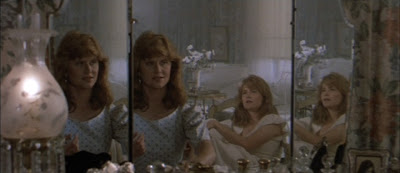
Sister, Sister (1987)
By the late ’80s, Leigh was in her mid-20s and entering a fertile period in her career, one frequently populated with characters plagued by childhood traumas. Mental illness was becoming a recurrent theme in her portrayals. “Troubled” would be the polite term for many of these women, but the less diplomatic “batshit” could certainly describe one or two. JJL’s first disturbed character of note was in Bill Condon’s directorial debut, Sister, Sister, an overheated Southern Gothic thriller in the lapsed Tennessee Williams mode. Here she plays Lucy, the psychically fragile, sheltered younger sister to Judith Ivey in an old-money plantation on the Lousiana Bayou. Lucy suffers from very vivid (and often eroticized) dreams. She claims she sees dead people and is mostly kept under lock and key by Ivey. When a potential suitor enters the picture in the form of Eric Stoltz, sisterly jealousy abounds and those locks tighten further. As it turns out, Ivey may be the real crazy one (not much of a twist), both sisters suffering from a kind of shared PTSD after murdering a local man (Stoltz’s older brother) who tried to molest them as teens.
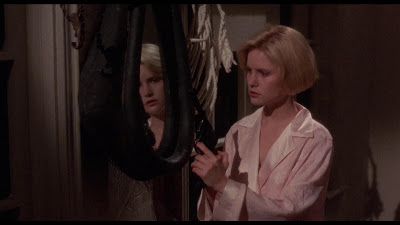
Heart of Midnight (1988)
The following year, Leigh played Carol, another fragile soul with a troubled past who inherits her recently deceased uncle’s sex club after recovering from a nervous breakdown. Carol wanders about the club talking to herself, singing to herself, hiring day laborers to spruce things up, despite the club being located in the seediest of neighborhoods. There are glimmers of hope that Carol may be able to turn her life around…until a gang of toughs led by a young Steve Buscemi burst through the doors and Carol falls victim to (you guessed it) another rape. To add insult to injury, the cop assigned to her case (Peter Coyote) is a Grade A sleazeball who isn’t sure if she’s telling the truth but decides to make awkward predatory advances on her nonetheless. Sadly for Carol (and this lackluster movie), he is the closest thing she’s got to a love interest. Soon Carol is having disturbing visions of the club’s sex dungeon past, and Club Midnight becomes a veritable echo chamber of her past traumas. Heart of Midnight may be the queasiest I’ve ever felt watching a JJL movie, more so than Hateful 8, not due to the grim subject matter, but because Leigh gives an 110% performance to a movie and director who are less than worthy of her talents.
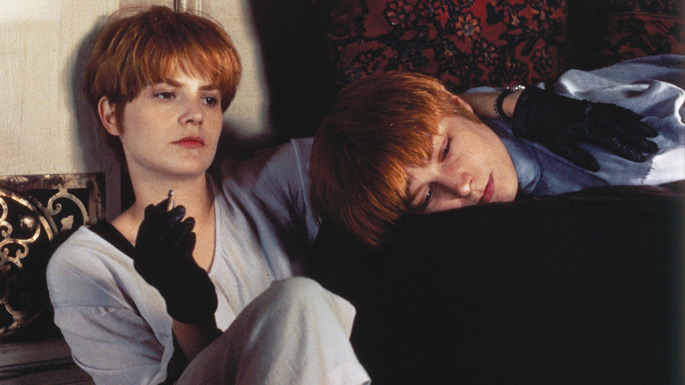
Single White Female (1992)
A few years later, Leigh would finally get her chance to nail the psychological thriller genre to the wall and play her most famous of “crazies,” Hedy, in Barbet Schroeder’s Single White Female. Unlike JJL’s previous borderline characters, Hedy’s psych problems derive from having lost a twin sister at an early age rather than suffering some violent childhood encounter. The film’s deft but decidedly genre-bound script by Don Roos allows JJL the space to grow into her psychosis. At first, Hedy seems like the perfect no-drama roommate to Bridget Fonda’s Upper West Side software designer. Then, some 30 minutes into the film when the clothes borrowing begins and the matching haircuts come out, we begin to realize Hedy is a needy, neurotic obsessive, or perhaps something worse. For a relatively boilerplate ’90s Hollywood thriller, Leigh’s performance in SWF is a carefully modulated thing of beauty. Just watch the scene where her character has to first seduce Fonda’s boyfriend (Steven Weber), then emotionally blackmail him, then convince him why he needs her, and then, when she doesn’t get her way, just as casually stab a stiletto heel into his eye. So much emotional territory to cover in one scene, and JJL does it seamlessly. Then, shoelessly.
The Working Girls: Tralala, Susie, Lois
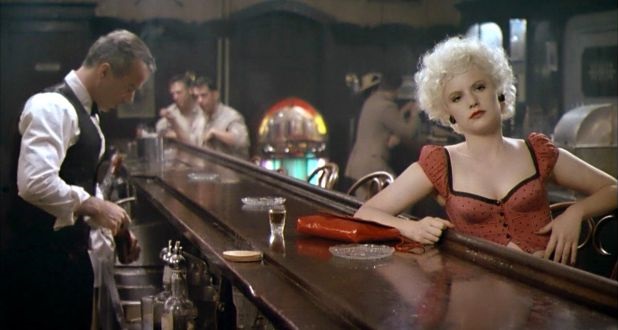
Last Exit to Brooklyn (1989)
By the early ’90s, Leigh’s career was in full ascendancy. Rather than expend her newly acquired industry capital in a slew of bubbly ingénue roles or big budget rom-coms, she chose to go deeper and darker, by exploring the seamier sides of the world’s oldest profession in several key smaller films. In a recent SAG-AFTRA retrospective of her work, Leigh describes an audition for 1990’s Pretty Woman wherein director Gary Marshall suggested she was playing the character of “Vivian” (later inhabited by Julia Roberts) as too morose. He explained that Vivian was still new to being a prostitute and “should be having more fun with it!” It was then when Leigh realized that the mainstream Hollywood portrayals of sex workers based on Roy Orbison songs was probably not the best way for her to go.
Despite her sing-songy name, Tralala in Last Exit to Brooklyn is nobody’s version of warm, fuzzy pop song (a tragic barroom blues number, perhaps). Part neo-realist Italian streetwalker in the Fellini-Masina tradition, part Horatio Alger nightmare by way of the BQE, she’s a byproduct of her working class Brooklyn neighborhood. She “turns tricks” by separating randy sailors from their pocket money, picking them up in rundown bars, then walking them out to the docks where her gang of male co-horts bop them over the head and steal their dough. Only on rare occasions does Tralala offer the full scope of her services, and when she does it’s usually for bigger payoffs from more well-to-do johns in Manhattan. Tralala’s not really looking for betterment across the Bridge; she’s already given up on that. She just wants the fattest, fastest buck she can get.
Leigh is in peak character-actress form here, her squeaky outer-borough accent and hip-thrusting vamp walk always teetering dangerously on the edge of parody, a perfect blend of Old Hollywood hooker homage and real-life working girl verité. Though Tralala ultimately suffers one of the cruelest, ugliest fates in movie history (i.e., being drunkenly gang-raped on the docks by a string of drunker men), Leigh portrays her as more of a world-weary fellow predator than a tragic victim. Whether employing her “count to ten” method of bar pickups, shouting her self-advertisement “best tits in the Western World” to a barroom full of leering johns or screaming drunken taunts as she’s being violated to bring on more men—”I’ll fuck ’em blind!”—Leigh does her best to remind you that Tralala is as much of an aggressor as her attackers. When all is said and done, she is a survivor. Even after her brutal rape, when the neighborhood boy who loves her comes to find her semi-conscious on a dirty mattress, it’s not Tralala who does the crying. It’s Tralala who comforts him.
Miami Blues (1990)
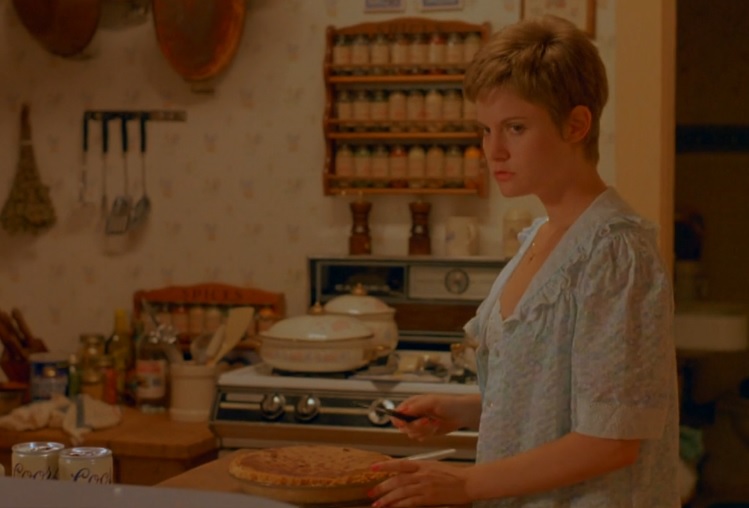
The following year, Leigh would play “Susie,” a different breed of prostitute in a small crime film co-starring Alec Baldwin. Though they share the same profession (if not the same climate), Susie from Lake Okeechobee couldn’t be further in personality from Brooklyn’s Tralala. Whereas Tralala is all jaded opportunism, Miami-Dade business major Susie still looks at the world with sun-kissed hopefulness, despite her dubious side gig. She is optimism personified—a multitasker with super-sized future plans. When she’s not meeting sociopathic career criminals in downtown Miami hotel rooms, she’s taking haiku courses, water ballet or Spanish lessons. She’s got “10 grand in a bank money CD” and big dreams to open a successful Burger World franchise. These plans all go to hell when she meets Freddy Frenger (Baldwin), and if there’s any tragic flaw to Susie it’s that she makes the mistake of pinning all her dreams to a no-good, lying cad. She probably shouldn’t have broken the first of rule of the call girl game when she kissed him on the lips during that first “date.” Leigh inhabits Susie as a good-hearted small town Florida girl with high hopes and low standards in men. “He never hit me,” she bluntly explains to cop Hoke Moseley (Fred Ward) at the end of the film, her simple explanation for how she could stay with Frenger as long as she did. Considering what Susie’s seen in life (and what JJL had already experienced in her career), that rationale almost makes sense.
Short Cuts (1993)
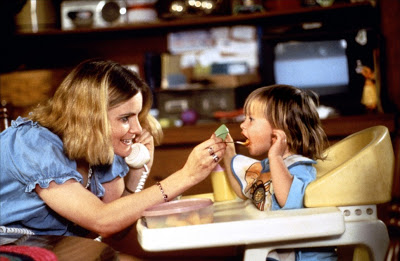
Leigh’s brief appearance in Robert Altman’s sprawling Short Cuts as phone sex operator and work-from-home mom, Lois, is a different kind of “working girl” performance. This time, there’s no violence perpetrated on her character, though the film’s narrative seems to suggest it’s Lois’s blasé attitude about her job and its effects on her marriage that prompts her long-suffering pool cleaner husband, Jerry (Chris Penn), to murder an innocent teenage girl in Griffith Park at the film’s end. Watching Lois casually dirty-talk anonymous strangers to orgasm on the phone while she’s changing his children’s diapers eventually drives Jerry to despair. Not to mention the fact that Lois is too tired after a full day of talking sex to have actual sex with him before bed. As Leigh plays her, Lois is just an overworked mom trying to make ends meet. But, as seen through her husband’s intensely jealous male gaze, she might as well be the worst of Mary Magdalenes.
The Jaded Addicts: Dorothy, Sadie
Mrs. Parker and the Vicious Circle (1994)
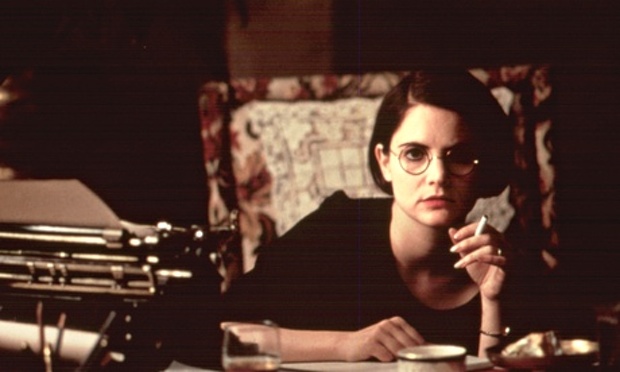
1994 was a very good career year for Jennifer Jason Leigh. Fresh off her success in Single White Female, she’d worked with Robert Altman in Short Cuts, then the Coen Brothers in The Hudsucker Proxy, playing the fast-talking, Hepburn-esque ’50s investigative reporter Amy Archer. Though a fun role that allowed her to employ a funnier accent, it didn’t exactly require her to “go deep.” That chance would soon come, however, when Altman suggested to colleague Alan Rudolph that he cast Leigh as legendary screenwriter and wisecrack practitioner Dorothy Parker in his upcoming biopic. Parker’s vocal inflections would be similar those Leigh employed in Hudsucker, but her cadence was slower, her witticisms harsher, her most withering remarks aimed directly at herself. The real-life Parker was known for her alcoholism as much as her acerbic wit. She was a highly literate depressive and generally disregarded the services she performed for Hollywood as “hack work.”
Leigh wisely plays Parker as one of the industry’s walking wounded, a boozy fountain of sugar-coated despair. She’s in love with her platonic writing colleague, Robert Benchley (Campbell Scott), but they both know their mercurial personalities will never allow for a traditional love relationship. Her self-hatred is palpable in every tossed-off quip, every bon mot another psychic bruise she’s trying to cover up. Though she suffers only one actual blow in entire movie (a slap from her alcoholic first husband played by Andrew McCarthy), Leigh, as Dorothy, reacts more with amusement than offense. It’s as if she’s saying: “Why bother slapping me? Can’t you see you see the damage I’m doing to myself on the inside is far worse than any silly man’s backhand?” Her Dorothy Parker is addicted, sure, but mostly to her own misery.
Georgia (1995)
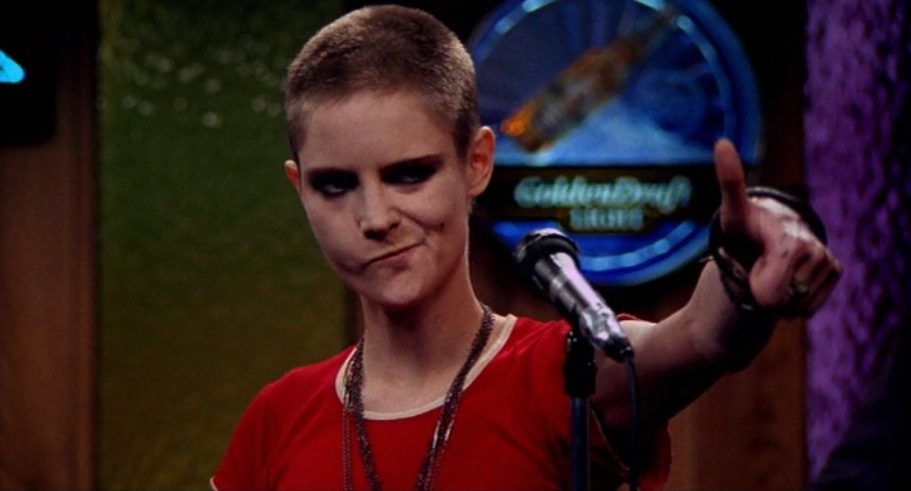
The next year, Leigh tackled a more personal portrayal of addiction in Georgia, a screenplay written by her mother, Barbara Turner, and reportedly influenced by her relationship with her own sister. Here, Leigh plays Sadie Flood, a hard-drinking, drugging and drifting alt-rocker who lives in the shadow of her older, more successful folk singer sister (Mare Winningham). Leigh’s Sadie is all jangly nerves, a vortex of quivering need. She doesn’t have what you’d call natural talent as a singer; the best compliment you could give her is that she is “raw” and persistent. She’s probably not a person you’d want to spend a lot of time with in real life, but Leigh’s unflinching portrayal always keeps you pulling for Sadie. You yearn for her to patch things up with her sister, to pull her life together, to finally hit those high notes. It might be Leigh’s most mannered performance, but it’s also one of her best. Though Georgia (or Leigh) didn’t get nearly the same amount of press, the film could easily be featured on a double bill with Nic Cage’s Academy Award-winning work as an alcoholic screenwriter in Leaving Las Vegas that same year.
The Cautious Romantics: Catherine, Sally, Lisa
Washington Square (1997)
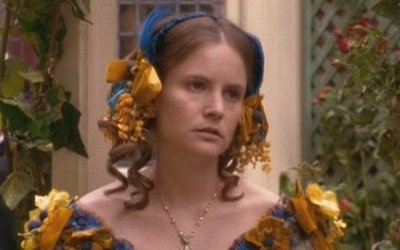
By the late ’90s, Leigh was into her mid-30s and entering that typically difficult age range for mainstream Hollywood actresses. However, a few women directors came to her rescue. The first was Angelica Huston in 1996 with the Showtime movie about a southern family with a history of abuse, Bastard Out of Carolina. This time, Leigh wasn’t playing the abused party but the mother of the abused. More notably the following year, Agnieszka Holland gave her a crack at period piece romance in an adaptation of Henry James’s Washington Square. Here, Leigh played the shy, clumsy and not terribly bright society wallflower, Catherine. Once again, Leigh’s character is caught between two lousy men: her domineering father (Albert Finney) who wants to protect his inheritance, and the handsome young suitor, Morris (Ben Chaplin), who’s been suspiciously courting her at society gatherings. Catherine develops enough self-awareness (and self-doubt) to realize that Morris may only be after her father’s money, but for a large stretch of the movie she allows herself to be cautiously optimistic that he’s not. In the end, Morris turns out to be the manipulative cad her father (and the audience) expected. Her father turns out to be something worse—a punitive miser. She doesn’t get the money or her man, but when the last will is read Leigh plays Catherine as oddly relieved. She’s finally free of both overbearing men and, in the process, has come to better know herself.
The Anniversary Party (2001)
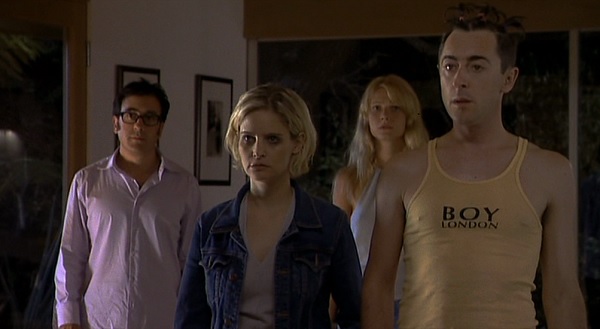
“Know Thyself” could easily be the alternative title to Leigh’s self-starring directorial debut, The Anniversary Party, several years later. This shot-on-video film plays like an extended, though entertaining, JJL therapy session. Leigh segues heavily autobiographical as Sally, a Hollywood actress “of a certain age” who’s just reunited with her writer/director boyfriend, Joe (Alan Cumming). She’s worried that her days as a successful thespian might be drying up, and a party guest is heard to remark about Sally that “she always gets robbed at the Oscars.” She loves Joe madly but is also suspicious of his new, younger blonde ingénue (Gwyneth Paltrow). Considering what occurred in real life with Leigh and Noah Baumbach years later (Greta Gerwig anyone?), these scenes now read as uncomfortably prophetic. It’s a trying film to watch at times, especially when the Ecstasy tabs come out and all the characters begin oversharing, with countless emotional rescues delivered poolside. The best scene comes near the end between Leigh and longtime real-life pal Phoebe Cates where they have a candid “real-talk” moment in front of a poster of the two of them from their Fast Times days. This time, the conversation is not about the men in their lives. Finally, a JJL film that passes the Bechdel Test!

Anomalisa (2015)
After her 40th Anniversary, Leigh’s own acting career began to enter the fallow period she’d foreshadowed in her directorial debut. Other than supporting roles playing supportive wives in big budget Hollywood films, and two small roles for then-husband Noah Baumbach, the movie-going public wasn’t seeing nearly enough of Jennifer Jason Leigh. It was for good reason. She’d become a mother in real life and reached the point where she nearly decided to retire. “I thought I’d had a good run,” she said of that time period in recent interviews. But year 2015 proved that her run was not quite over. Though her role in The Hateful 8 made the bigger splash and finally earned her an Academy Award nomination, it’s the animated Anomalisa that would prove more interesting in the long term, a harbinger of bigger, better roles to come.
Here, Leigh plays Lisa, one of only two characters in the movie not voiced by Tom Noonan. To the ears of salesman Michael Stone (David Thewlis), Lisa’s voice is a revelation the first time he hears it, as is Leigh’s to the audience after some years away. Lisa is earthy, natural, hesitant. She’s made of opposable plastic but also very real. She’s an older woman (40s? 50s? hard to tell with puppets), but she’s managed to preserve some degree of optimism in her years. She’s a scarred character—literally, her face is scarred from an unnamed accident—but she’s learned how to protect herself in life and in love.
Despite being limited to an audio-only performance, Leigh’s “Lisa” blooms in the mind, a rich compendium of her past characters. There’s a little bit of Stacy’s innocence, some of Catherine’s embarrassment. There’s a bit of Agnes and Tralala’s bravery, some of Dorothy’s self-deprecation. There’s a good deal of Susie’s sunniness and maybe just a touch of Hedy’s disturbing neuroses, though I’d guess Lisa is taking meds for that. Best of all, Lisa suffers zero physical violence in the film. About the worst thing that happens to her is being on the receiving end of an awkward bout of oral sex.
The Hateful 8 (2015)
Which brings us back to…Daisy Domergue. Is it a role worthy of Leigh’s exceptional abilities? A savvy career revitalizer on the order of what Tarantino did for Robert Forster, John Travolta, Pam Grier, Michael Parks, and Christoph Waltz? Is it QT’s bloody valentine to her prior black + blue filmography or a hateful “Dear Jen” breakup letter delivered with all the callousness of one of John Ruth’s sudden whacks? Where the hell does Daisy fit into the JJL resume?
She’s definitely no kinda good girl and arguably the baddest of Leigh’s bad girls. She’s got a whole lotta crazy in her and, though not technically a working girl, you could easily imagine Daisy turning a trick if pressed. Is she jaded? “Well, duh” to use Daisy’s own favored expression. Is she an addict? Sure, addicted to beef jerky and jarring racial epithets. Is she hopelessly romantic? Not by a country mile, though she certainly seemed to love her redneck brother (Channing Tatum) a little too much before his brains were sprayed into her lap. After a second viewing of The Hateful 8, I’ve come to the conclusion that Daisy Domergue is in a league all her own, Leigh’s first gleefully repugnant antagonist. To fully appreciate the harpy in a furry ushanka cap that she and Tarantino have created, you must drink in her delicious nastiness like the mug of poisoned coffee later gulped down by Kurt Russell’s John Ruth. You must take it in heavy slugs, not tentative sips. Like so many of Jennifer Jason Leigh’s brilliantly bruised and bruising portrayals, it’s a performance that refuses to flinch.
 MATT BURCH